2023
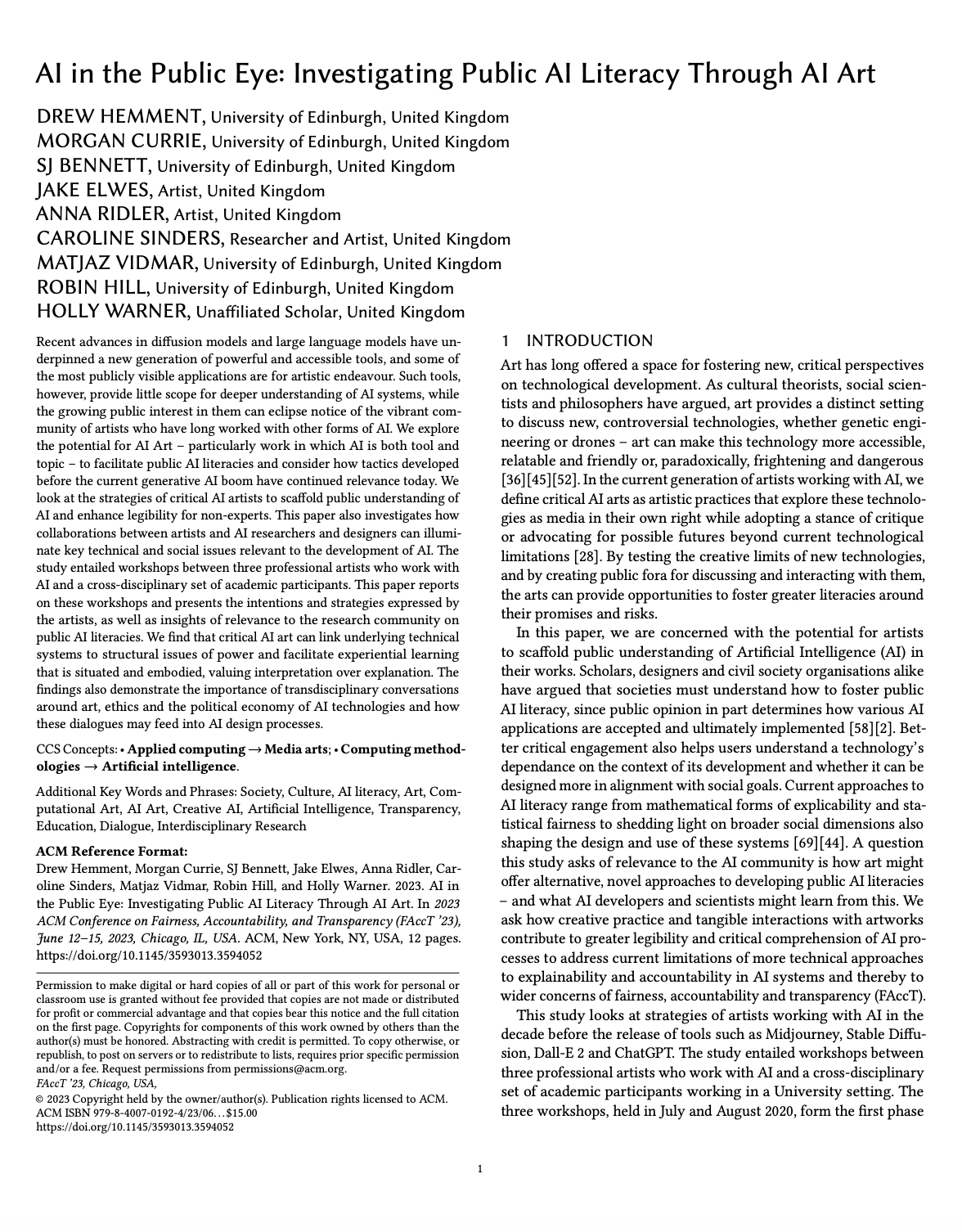
AI in the Public Eye: Investigating Public AI Literacy Through AI Art
ACM Conference on Fairness, Accountability and Transparency (FAccT), Chicago | June 2023
A collaborative paper asking whether AI art - particularly work in which AI is simultaneously tool and subject - can serve as a site of public education about how AI systems actually function. It argues that critical artists who worked with machine learning before the diffusion model boom developed strategies for making AI legible to non-experts that remain undervalued and newly relevant: slowing down the encounter with the technology, foregrounding its materials and labour and refusing the seamlessness that commercial tools are designed to project. The paper draws on workshops conducted with three practicing artists and a cross-disciplinary group of researchers.
Read in full →2022
Clocks, Colonies and the Living World: Time, Power and Resistance in Computational Art
Society for Literature, Science and the Arts (SLSA), Purdue University | October 2022
A keynote address examining how different computational systems of timekeeping - digital, Unix and blockchain time - progressively unmoor us from natural and ecological temporal frameworks. Drawing on Circadian Bloom, The Shell Record and Myriad (Tulips), the talk argues that the standardisation of time is not a neutral process but one shaped by power, commerce and colonialism and that the labour of making datasets by hand constitutes a deliberate resistance to the speed-optimised logics of commercial data production. Proposes the natural world - flowers, shells, circadian rhythms - as a site of alternative temporal knowledge that persists beneath computational standardisation.
Read in full →2017
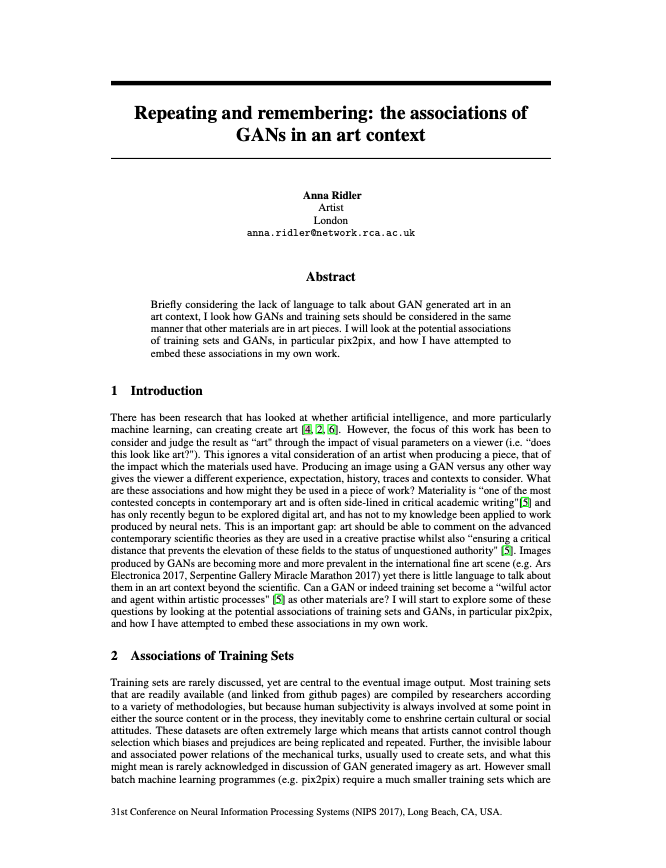
Repeating and remembering: the associations of GANs in an art context
Workshop on Machine Learning for Creativity and Design, NeurIPS 2017, Long Beach | December 2017
An early argument that GANs and their training sets should be understood as artistic materials with their own histories and associations - in the same way that oil paint, marble or found footage carry meaning beyond their technical properties. The paper contends that the choice of training data is not a neutral or merely practical decision but an expressive one, and that artists working with machine learning inherit the accumulated associations of whatever they train on. Written in 2017, before dataset critique became a widespread concern, it anticipates much of the later conversation about the ideological content of AI systems.
Read in full →